

High beam
What do the high beams do?
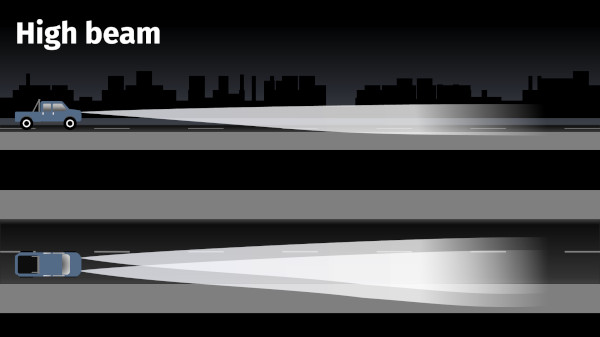
The high beams are a lighting function of the headlights. They are designed to illuminate the road ahead of the vehicle over a long distance.
Unlike the low beam, the high beam does not have a comparable light-dark boundary to limit the glare experienced by oncoming road users. This allows a greater proportion of the light to be directed into the distance.
High beams can severely dazzle other road users. They must therefore only be used if doing so does not dazzle anyone.
Light distribution of high beams
The light distribution is designed for a long range. To achieve this, a high luminous intensity is generated, particularly in the central areas in front of the vehicle.
The range of a high beam cannot therefore be assessed solely on the basis of the luminous flux or the value given in lumens. How the light is spatially distributed is also a decisive factor.
Further typical light distributions are shown in the article Beam patterns of vehicle headlights.
Pencil Beam
A particularly tightly focused light distribution is known as a pencil beam. It concentrates the light onto a comparatively narrow area, thereby enabling high luminous intensity in the main beam direction.
A pencil beam is therefore particularly suitable for applications where a long range is more important than wide illumination.
Reference number
For high beam headlights, the reference number indicates the maximum luminous intensity of the high beam. The higher the reference value, the higher the maximum luminous intensity, in principle.
The reference value is also relevant for combinations of several high-beam headlights switched on simultaneously. UN regulations limit the total permissible maximum luminous intensity of high beams operated simultaneously. The reference values of the individual headlights enable this combination to be assessed.
Statutory requirements
Defined photometric requirements apply to main-beam headlamps. Within the scope of the ECE regulations, UN Regulation No. 149 in particular sets out requirements for the light distribution and luminous intensity of main-beam headlamps. Among other things, it specifies minimum values at certain measurement points and a maximum permissible luminous intensity.
Requirements regarding the mounting, number and electrical circuitry of headlamps on the vehicle, on the other hand, are governed in particular by UN Regulation No. 48.