

Vehicle lighting
What does vehicle lighting comprise?
Vehicle lighting comprises the lighting systems of a vehicle that serve to illuminate the road and ensure visibility and signalling to other road users.
These include headlamps and lights with various lighting functions. Some enable the driver to see the road and their surroundings. Others make the vehicle, its position or specific driving manoeuvres visible to other road users.
For vehicles on public roads, there are mandatory requirements governing the relevant lighting equipment.
Seeing and being seen
The various functions of vehicle lighting can generally be categorised according to their purpose.
Headlighs are primarily used to illuminate the road ahead of the vehicle. The most important lighting functions include low beam and high beam.
Other lights are mainly used to make the vehicle visible to other road users or to convey information. These include, for example:
- Position lights and parking lights
- Daytime running lights
- Rear lights
- Stop lights
- Direction indicators
- Backup lights
- Fog lights
- Fog tail lights
- License plate lights
The individual lighting functions differ in terms of their purpose, light distribution, light colour and the requirements regarding their position on the vehicle.
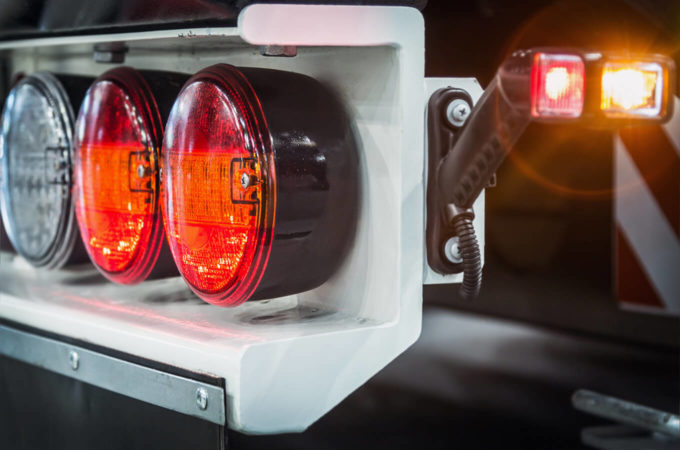
Requirements for vehicle lighting
Regulations governing road traffic specify which lighting devices are required or permitted and which requirements they must meet.
In Europe, the relevant ECE regulations are of particular importance. They set out requirements for the approval of lighting equipment and for its fitting to the vehicle.
A distinction must be made between the requirements for the individual lamp and the regulations governing its installation on the vehicle. Not every approved lamp may be fitted in any position or used for a lighting function other than that for which it is intended.
Light distribution for driving beams
With driving beams, it is not just the amount of light produced that is crucial. The light must be distributed in a targeted manner in accordance with the respective function.
With low beam headlights, for example, the road must be adequately illuminated without unduly dazzling oncoming road users. With high beam headlights, on the other hand, the priority is to illuminate the road ahead over a long distance.
The resulting light patterns are subject to defined photometric requirements. The principles of measuring and evaluating light are explained in the article on photometry.
Distinction from work lighting
Work lights, on the other hand, are used to provide targeted illumination of a work area. They are not classified as driving headlights intended for regular use on public roads. Their purpose is, for example, to illuminate the surroundings of an industrial truck, a construction machine or a commercial vehicle whilst work is being carried out.
Vehicle lighting for road use and work lighting therefore fulfil different purposes and are subject to different requirements.